
Program Details:
- Credit Hours: 147
- Courses in Program: 53
- Formats: Online or on campus
- Cost Per Credit: Varies; see below
- Estimated Completion Time: 33 months

Build the knowledge and skills you need to provide a critical healthcare service—and become a trusted community resource— with D’Youville’s three-year PharmD program.
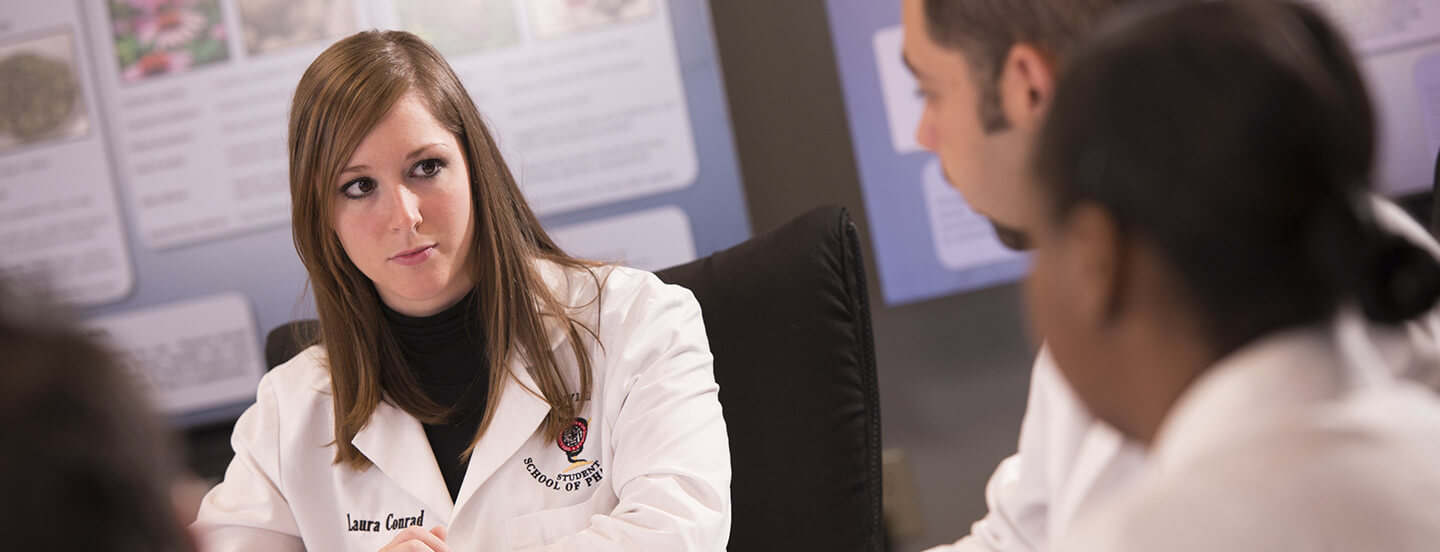
As a leader in healthcare education, D’Youville is dedicated to building the next generation of pharmacy professionals and connecting them to early career success. Our Doctor of Pharmacy (PharmD) program is designed to offer you the education you want in a format that works for you. Choose from on-campus study or from an online program that includes six short, on-campus learning experiences plus in-person clinicals.
Whichever option you choose, you’ll be able to finish in as little as 33 months thanks to our accelerated trimester format. This schedule prepares you to enter the job market one year faster than peers at other institutions.
When you join our program, you’ll also be joining a community dedicated to helping you reach your goals. You’ll be matched with a faculty advisor who will work with you throughout your education. On-campus students can complete clinicals throughout western New York. If you study online, DYU staff will work with you to find placement sites anywhere in the U.S.
YOU WILL:
- Prepare to practice in an interprofessional patient-centered environment.
- Assist patients in managing their medication regimens and solve problems related to drug therapy regimens.
- Learn to communicate effectively with patients and other health care practitioners.
- Gain skills for developing and evaluating programs to improve community health.
- Build leadership and collaboration skills through problem sets, case analyses and class service projects.
- Complete six different pharmacy rotations lasting six weeks each.
Three years. One PharmD program. A world of career possibilities.
As a graduate of our PharmD program, you’ll be equipped to practice at the top of your skills in clinical pharmacies, retail pharmacies, or research settings.
COURSES AND REQUIREMENTS
ADMISSION REQUIREMENTS
The D’Youville School of Pharmacy participates in PharmCAS, the Pharmacy College Admission Service. To apply to the D’Youville Professional Pharmacy Program (PharmD), please complete the online PharmCAS application.
The PCAT is not required. However, if you have taken the PCAT, the D’Youville School of Pharmacy Admissions Committee will review and consider your test scores along with the entirety of your PharmCAS(https://www.pharmcas.org/node/32/webform/submission/184) application.
You’ll need to submit:
- Canadian residents interested in the program will need to apply for and obtain a Federal Form I-20
- PCAT Not Required
- Official transcripts from ALL colleges previously attended
- Two Letters of Reference, at least one Letter of Reference must be from an academic professor; the other letter may be from an employer, supervisor, or a faculty or health care advisor.
- All foreign transcripts must be verified through PharmCAS, World Education Services (WES), or The Evaluation Company (TEC).
- D’Youville University School of Pharmacy requires an English language test score for applicants whose native language is not English. If the applicant has attended an English-speaking institution (college/university) for two or more years as a full-time student (12 or more credit hours per term), they may be exempt from this requirement. However, based upon the Admissions Interview, for applicants whose native language is not English, the Admissions Committee may require one of the accepted English language tests to be completed prior to making a final decision on their application (TOEFL, IELTS, or DET are acceptable).
- Completion of all required undergraduate prerequisite courses, which can be viewed in the D’Youville University catalog: https://catalog.dyouville.edu/degree-programs/pharmacy/pharmacy-pharm-d/index.html#admissionstext
TUITION AND FEES
Tuition and fees vary based on your program of study and whether you are considered a full-time student. Financial aid is available for those who qualify and can be applied to full-time status.
Previous college credit can help lower the overall cost of your education. Please note that the School of Pharmacy generally does not accept transfer credit into the professional phase of the PharmD program.
| COST | Total | |
|---|---|---|
| Full Program Tuition | $178,400 | |
| Full Program Fees | $10,720 | |
| Full Program Total | $189,120 | |
| COST | Total | |
|---|---|---|
| Estimated First-Year Salary & Additional Earning Potential | $109,000 | |
| Balance After First-Year Earnings Included | $88,120 | |
CAREER OUTCOMES
Pharmacists are in demand and well compensated. The Bureau of Labor Statistics reports that the median national wage for pharmacists was $137,480 as of May 2024.
For more information about the job outlook for pharmacists, visit the Bureau of Labor Statistics Occupational Outlook Handbook.
Community Pharmacists
Community pharmacists working in retail settings dispensing medications, advising patients on drug effects and interactions, and providing primary health care services such as flu and shingles vaccinations.
Clinical Pharmacists
Clinical pharmacists work as part of an integrated healthcare team in hospitals, clinics, and other healthcare settings. They provide advice on dosage and timing of medications, efficacy of specific pharmaceuticals and their alternatives, and the role of medications in the treatment of a variety of health conditions and diseases.
Consultant Pharmacists
Consultant pharmacists provide advice on medications to institutions such as hospitals or health insurance companies. Some consultant pharmacists also provide direct consultation to patients through their own private practices.
Industry Pharmacists
Industry pharmacists apply their knowledge to roles in the pharmaceutical industry in areas ranging from marketing to sales to research.
Government Pharmacists
Pharmacists working in federal agencies serve in organizations such as the Veterans Administration, Department of War, Indian Health Service, U.S. Food and Drug Administration, Centers for Disease Control and Prevention, National Institutes of Health, and the U.S. Public Health Service.
Academia Pharmacists
Academic careers enable pharmacists to teach, mentor, and conduct research while shaping the future of health care. Opportunities include clinical practice, pharmaceutical sciences, and social and administrative sciences, with roles in both classroom and leadership positions. These paths allow pharmacists to influence student pharmacists, expand knowledge, and serve their communities.